SSC CGl Recruitment 2026 Complete syllabus With Topics- Check now, SSC CGL Recruitment 2026 Exam pattern And Syllabus, SSC CGL 2026 Syllabus, SSC CGL,
Staff Selection Commission (SSC)CGl 2026 Selection Complete, mainly for Step
- Exam ( Tier 1 and Tier 2 )
- Skill test
- Document Verification
- Physical Test- ( Valid in specific Post)
SSC CGL Exam Pattern And Syllabus (SSC CGL 2026 Syllabus)
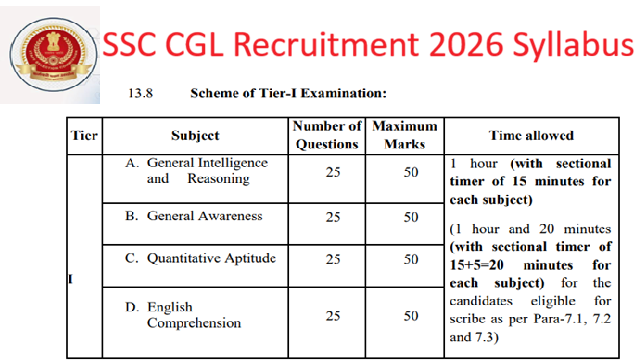
- Tier 1 Exam Pattern
- Paper Mode: Online
- Question Type: Objective Type Of Question
- Time For Tier 1 Exam: 1 Hour ( 60 Minutes )
- Total Question: 100
- Total Marks: 200 ( Each Question Holds Two Marks )
Note – SSC CGl Tier 1 Exam Includes 1/2 (0.5 Marks ) Negative Marking
Tier 1 exam Syllabus-
- General Intelligence & Reasoning
- General Awareness
- Quantitative Aptitude (Maths)
- English Comprehension
Note– Each Subject Holds 25 Questions and 50 Marks
Tier 1 Exam Complete Detailed Syllabus- (SSC CGL 2026 Syllabus)
SSC CGL Tier 1: Preliminary Screening The Tier 1 exam is a qualifying computer-based test featuring 100 multiple-choice questions worth a total of 200 marks, to be completed in 60 minutes.
1. General Intelligence & Reasoning-
This section assesses logical thinking, pattern recognition, and analytical abilities.
- Verbal Reasoning: Coding-decoding (letter shifting, numerical coding), blood relations (family trees, coded relations), analogies (semantic, symbolic, number-based), Venn diagrams (syllogisms, set intersections), and logical series (number, alphabet, and alpha-numeric).
- Non-Verbal & Spatial Reasoning: Matrix coding, paper folding & cutting, mirror and water images, embedded figures, completion of patterns, and cube/dice orientation.
Analytical Puzzles: Linear and circular seating arrangements, floor-based puzzles, and basic scheduling/ranking logic.
2. Quantitative Aptitude
Focuses on fundamental numerical ability and basic mathematical proficiency.
- Arithmetic Operations: Percentages, profit, loss, and deep-dive discounts, partnership business, mixtures, and allocations.
- Core Numeracy: Computation of whole numbers, fractions, decimals, relationship between numbers, LCM & HCF, and ratio & proportion.
- Time & Motion: Time and work dynamics (including pipes and cisterns), speed, distance, and time (including trains, boats, and streams), and compound/simple interest structures.
3. General Awareness-
Tests your knowledge of the world around you and basic academic disciplines.
- Dynamic GA: National and international current affairs spanning the last 6 to 12 months (focusing on government schemes, summits, sports awards, appointments, and obituary records).
- Static GK & Arts: Indian classical & folk dance forms, famous musicians and musical instruments, art festivals, national parks, wildlife sanctuaries, and biosphere reserves.
- Social Sciences:
History: Indus Valley Civilization, Vedic age, Buddhism/Jainism, Maurya/Gupta empires, Delhi Sultanate, Mughal era, and the Indian National Movement (1857–1947).
Geography: Solar system, Indian river systems, mountain passes, soil types, climate zones, and major minerals/industries.
Polity: Making of the Constitution, Fundamental Rights & Duties, Directive Principles (DPSP), emergency provisions, and the structure of the Parliament/Judiciary.
Economics: Micro vs Macro introduction, five-year plans, inflation types, monetary policies (RBI tools), and demand & supply concepts.
- Basic Sciences:
Physics: Units and dimensions, work, power & energy, light & optics, gravitation, and sound.
Chemistry: Periodic table trends, chemical reactions, acids, bases & salts, and everyday chemistry (allotropes of carbon, common gases).
Biology: Cell structure, human diseases & deficiencies, plant & animal kingdoms, human digestive/circulatory systems, and vitamins.
4. English
Comprehension evaluates foundational literacy, grammar mastery, and vocabulary. Grammar & Syntax: Subject-verb agreement, tenses, prepositions, articles, error spotting, phrase replacement, active/passive voice conversions, and direct/indirect narration.
- Vocabulary: Synonyms, antonyms, one-word substitutions, idioms & phrases, and spelling error detection.
- Reading Ability: Cloze tests (blank filling within a passage) and short reading comprehension passages to test contextual understanding.
SSC CGL Tier 2 Exam Pattern Syllabus-
Exam Pattern-
Tier 2 is the primary scoring stage, Includes three papers. Paper I is compulsory for all posts, whereas Papers II and III are specific to certain posts, such as Junior Statistical Officer (JSO) and Statistical Investigator.
Tier 2 Exam Includes Three Papers
- Paper I: Includes three Sections
1 Section-
- Question: 60
- Marks: 180 (3 marks each Question)
- Time: 1 Hour (Sectional timer: 30 mins per subject)
2 Section-
- Question: 70
- Marks: 210 (3 marks each Question)
- Time: 2 Hours
3 Section-
- Question: 20
- Marks: 60 (3 marks each)
- Time: 15 Minutes
- Paper II
- Question: 100
- Marks: 200 (Each question 2 Marks)
- Time: 2 Hours
- Paper III
- Question: 100
- Marks: 200 (Each question 2 Marks)
- Time: 2 Hours
SSC Tier 2 Exam Detailed Syllabus-
Tier 2 is the decisive phase for final selection and post-allocation. It features highly specific papers tailored to the job profiles.
Paper I –
Mandatory for All Posts. Every candidate targeting Group B and Group C posts must clear this paper, which is split into three core sections
Section I: Mathematical Abilities & Advanced Reasoning.
Advanced Math (Algebra & Geometry): Basic algebraic identities, linear equations, graphs, elementary surds, triangles and their various centers (congruence and similarity), circles (chords, tangents, angles subtended), quadrilaterals, regular polygons, and right prisms/circular cones/cylinders/spheres.
Trigonometry: Trigonometric ratios, complementary angles, height and distance problems, and standard identities like $\sin^2\theta + \cos^2\theta = 1$.
Data & Logic: Statistics & Probability: Calculation of mean, median, mode, standard deviation, and variance. Simple problems on probability (coins, dice, cards).
Advanced Reasoning: Critical reasoning, statement-assumption, statement-conclusion, course of action, data sufficiency, and complex matrix arrangements.
Section II: English Language & Advanced General Studies
Deep English Literacy: Advanced reading comprehension (narrative, essayistic, and fact-based), complex cloze tests, para-jumbles (sentence reordering), and intensive vocabulary metrics.Comprehensive
General Studies: In-depth evaluation of the Indian administrative machinery, constitutional amendments, fiscal policies, macroeconomic principles, and detailed historical socio-economic reforms.
- Section III: Computer Proficiency & Skill Test
Digital Literacy-
Computer Basics: CPU, input/output devices, memory organization, backup devices, and port configurations.
Software: Windows OS basics, MS Word, MS Excel, and MS PowerPoint shortcuts and commands.
Internet & Security: Web browsing, searching, managing email accounts, hacking prevention, basic networking terms, and malware/virus definitions.
DEST (Data Entry Speed Test): A hands-on typing assessment requiring approximately 2,000 key depressions in 15 minutes to evaluate accuracy and speed.
Paper II:
Junior Statistical Officer (JSO)A specialized paper dedicated strictly to candidates applying for statistical cadres.
- Statistical Analysis: Methods of data collection (primary vs secondary), classification, tabulation, and diagrammatic/graphical representation of data (histograms, pie charts, ogives).
- Core Statistics: Measures of central tendency (mean, median, mode, geometric mean, harmonic mean), measures of dispersion (range, quartile deviation, mean deviation, standard deviation, coefficient of variation).Advanced Theory: Moments, skewness, and kurtosis. Correlation and regression analysis (scatter diagrams, product-moment correlation coefficient, linear regression lines).
- Probability & Sampling: Definition of probability, conditional probability, Bayes’ theorem, random variables, probability distributions (Binomial, Poisson, Normal). Sampling concepts, random vs non-random sampling, and sampling errors.
Paper III:
Assistant Audit/Accounts Officer (AAO)An elite paper tailored for candidates tracking finance, auditing, and corporate accounting roles.
Financial Accounting:Basics: Nature and scope of accounting, Generally Accepted Accounting Principles (GAAP), concepts of dual aspect, journal matching, ledger balancing, trial balance, rectification of errors, and manufacturing/trading/profit & loss accounts.
Depreciation Accounting: Methods of recording depreciation (straight-line vs written-down value methods).
Economics:Microeconomics: Theory of demand and supply, consumer equilibrium, indifference curve analysis, market structures (perfect competition, monopoly, monopolistic competition, oligopoly), and pricing theories.
Macroeconomics & Indian Economy: National income accounting (GDP, GNP, NDP, NNP), functions of money, role of the Finance Commission, economic reforms in India (post-1991), poverty, unemployment, and infrastructure growth.
Important Links
| SSC CGL Recruitment 2026 Notification | Check Now |
| SSC CGL Recruitment 2026 Official Notification | Check Now |
| CDAC Vacancy 2026 Official Notification Release 900+ Post Check details | Check Now |
| Other Latest Govt Job | Check Now |